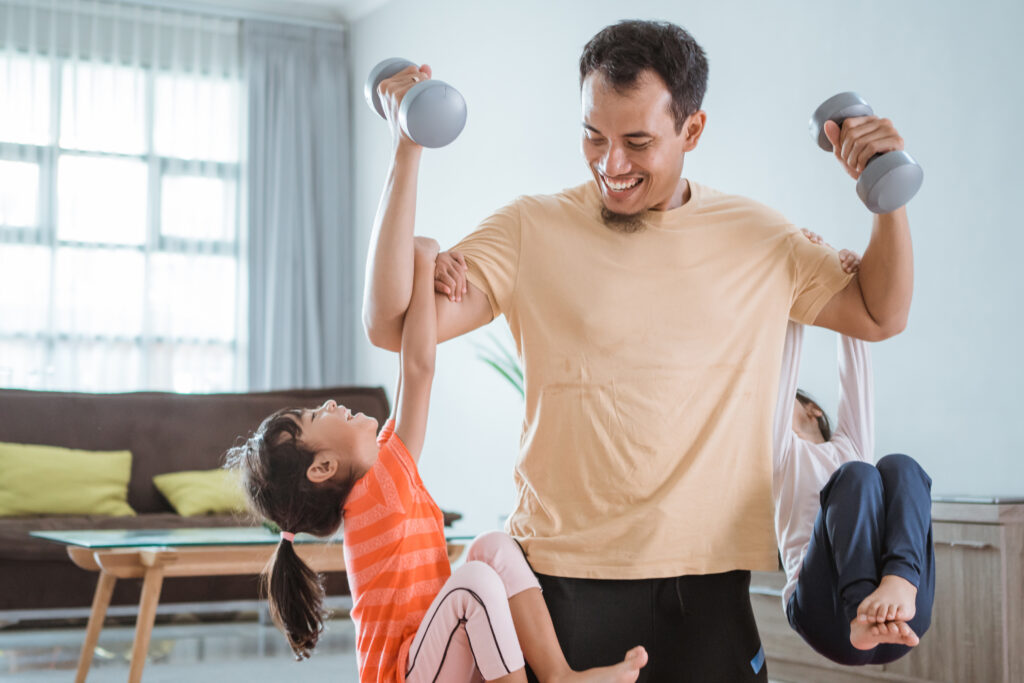
How Parents’ Habits Shape a Child’s Relationship With Fitness
Introduction: Parents influence on child fitness begins with daily habits and attitudes toward movement.
Children don’t learn fitness from instructions alone they learn from observation. The way parents talk about exercise, food, and body image directly shapes how children view health for life.
Why Parents Influence on Child Fitness Matters
Children naturally mirror the behaviors they see at home. If movement is treated as normal, enjoyable, and part of everyday life, children are more likely to develop a positive relationship with fitness.
Research consistently shows that parental lifestyle habits strongly predict a child’s physical activity levels.
When parents model:
Children internalize those patterns.
Modeling Is More Powerful Than Motivation
Telling a child to “go play outside” while remaining sedentary sends mixed signals. On the other hand, when parents actively participate in physical activities, children associate fitness with connection and fun.
Active modeling may include:
Family walks
Weekend sports
Stretching together
Limiting screen time
Children perceive fitness as part of life not as punishment.
Language Shapes Long-Term Attitudes
The way parents talk about exercise deeply impacts a child’s mindset.
Positive language:
“Movement makes us strong.”
“Exercise helps us feel good.”
“Our bodies are powerful.”
Negative language:
“I need to burn calories.”
“I feel guilty for eating that.”
“Exercise is exhausting.”
Children absorb both consciously and subconsciously.
The Emotional Side of Fitness
Parents influence on child fitness is not just physical it’s emotional. When children see parents using movement to manage stress in healthy ways, they learn emotional regulation through activity.
For example:
Going for a walk after a stressful day
Stretching instead of reacting impulsively
Practicing deep breathing
These habits teach coping strategies beyond physical fitness.
Screen Habits and Sedentary Behavior
Parents set the tone for screen use. If devices dominate daily life, children adopt similar patterns.
Healthy modeling includes:
Balanced tech habits support an active lifestyle.
Consistency Over Perfection
Children don’t need perfect parents. They need consistent examples.
Even small daily habits like:
create powerful long-term influence.
Building a Positive Relationship With Fitness
When children grow up seeing movement as:
Enjoyable
Normal
Non-punitive
Connected to wellbeing
they are more likely to maintain active lifestyles into adulthood.
Fitness becomes identity-based rather than obligation-based.
Long-Term Benefits of Positive Modeling
When parents influence on child fitness is intentional and positive, children often show:
The foundation starts at home.
Conclusion
The link between muscle strength and emotional regulation in kids is powerful and often overlooked. When children build physical strength, they also build emotional stability.
At FitKid Club, we believe movement is not just about fitness it is about helping children grow stronger inside and out. Strong bodies truly help create calm, confident minds.
Join the world’s #1 Kids Fitness & Wellness Community.
✔ Designed for families everywhere
✔ Transform your child’s habits
✔ Reduce screen dependency
✔ Build confidence, energy, and lifelong wellness
Get your FREE consultation now:
➡ https://zfrmz.in/to4uqXcLgJjZF0iczDtI
Stay inspired with tips, workouts, and nutrition guidance for kids and families: